
Imagine you’re running Facebook and Instagram ads for your business. People click on your ads, visit your online page, and then leave without contacting you. What could be the problem?
Sometimes, the issue isn’t your advertising campaign. It could be the page visitors land on.
This is where understanding landing page vs website becomes important.
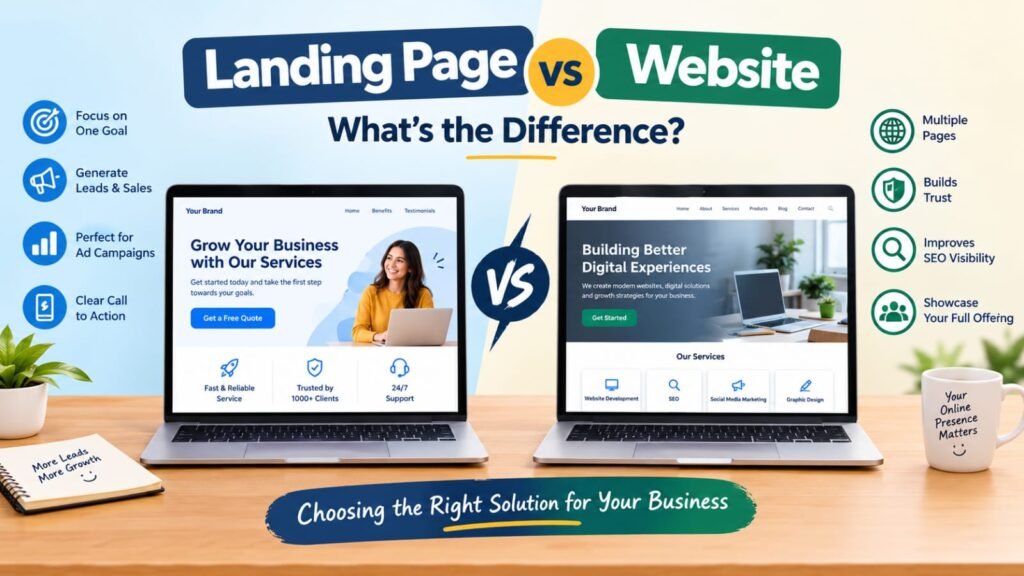
Both landing pages and websites play an important role in digital marketing, but they serve different purposes. A website helps customers explore your business, understand your services, and build trust. A landing page focuses on a specific goal, such as generating leads, booking appointments, or selling a product.
So, which one does your business actually need?
In this guide, we’ll explain the difference between a landing page and a website, their benefits, when to use each, and how to choose the right solution for your business.
What Is a Website?
A website is a collection of connected web pages available under a domain name. It provides customers with information about your business, products, services, and contact details.
Think of your website as your business’s digital home. It allows potential customers to learn about your brand, explore your offerings, and decide whether they want to work with you.
A typical business website may include:
- Homepage: Introduces your business and highlights what you offer.
- About Us Page: Shares your company’s background, experience, and values.
- Services Page: Explains your services and how they help customers.
- Product Pages: Showcase your products, features, and pricing.
- Blog: Provides useful information and supports your SEO strategy.
- Contact Us Page: Makes it easy for customers to call, email, or contact you.
- Testimonials or Reviews: Helps demonstrate customer experiences and build trust.
With WordPress website development, businesses can create professional, mobile-friendly websites that suit their needs and can be expanded as they grow.
Benefits of Having a Business Website
1. Build Brand Credibility
A professional website helps customers understand who you are, what you do, and how your business can help them.
2. Stay Available Online 24/7
Customers can explore your services and find your contact information even when your office or shop is closed.
3. Improve Google Visibility
With useful content, technical optimisation, and relevant SEO strategies, your website can attract potential customers searching for your products or services.
4. Showcase Your Complete Offering
You can present multiple services, products, projects, and business details in one place.
5. Support Long-Term Business Growth
As your business expands, you can add new service pages, blog posts, product categories, and other features.
A website doesn’t automatically guarantee traffic or sales. Its performance depends on factors such as design, usability, content quality, SEO, and your overall marketing strategy.
What Is a Landing Page?
A landing page is a focused web page designed to encourage visitors to take a specific action.
Unlike a typical business website, which offers several pages and navigation options, a landing page usually focuses on one offer and one primary conversion goal.
For example, a business running an advertisement for website development might send visitors to a landing page explaining the service, highlighting its benefits, and encouraging visitors to request a quote.
A landing page may include:
- A clear and compelling headline
- A short introduction to the offer
- Key benefits and features
- Relevant images or videos
- Testimonials or trust signals
- A contact form or WhatsApp button
- A strong call-to-action (CTA)
Common landing page goals include generating leads, booking consultations, promoting special offers, collecting registrations, and selling specific products.
Benefits of a Landing Page
1. Focus on One Goal
A landing page directs visitors towards one main action instead of asking them to explore several unrelated pages.
2. Support Lead Generation
Contact forms, call buttons, and WhatsApp integrations can make it easier for interested visitors to enquire about your services.
3. Support Advertising Campaigns
You can create a dedicated landing page for a particular Facebook or Instagram ad campaign, service, or offer.
4. Make Performance Easier to Measure
You can track relevant actions, such as form submissions, calls, bookings, or purchases, and evaluate campaign performance.
5. Test Different Offers and Messages
You can experiment with headlines, content, offers, and page layouts to understand what resonates with your target audience.
A well-designed landing page can support conversions, but results are not guaranteed. Your offer, audience, traffic quality, page experience, and follow-up process all matter.
Landing Page vs Website: Key Differences
Although both are important digital assets, their main purpose and structure are different.
| Feature | Website | Landing Page |
|---|---|---|
| Main purpose | Build an overall online presence | Encourage a specific action |
| Structure | Usually multiple connected pages | Usually one focused page |
| Navigation | Multiple menus and links | Minimal or limited navigation |
| Content | Covers the business, services, products, and more | Focuses on one offer or campaign |
| Primary goal | Inform, engage, build trust, and support business goals | Generate a lead, booking, registration, or sale |
| SEO opportunities | Multiple pages can target different relevant searches | Can target a specific search intent or topic |
| Marketing use | Long-term brand presence and customer discovery | Focused campaigns and conversion journeys |
| Common CTA | Explore services, contact us, view products | Book now, enquire now, sign up, or buy now |
| Best suited for | Businesses needing a comprehensive online presence | Businesses promoting a specific offer or action |
The key difference: A website helps people explore your business, while a landing page guides them towards a particular action.
However, a landing page can also be part of a larger website. The distinction is mainly about its purpose, not simply the number of pages.
Landing Page vs Website: Which Is Better for Your Business?
The answer depends on your business goals, budget, audience, and marketing strategy.
Neither option is universally better. They solve different problems.
When Should You Choose a Website?
A complete business website is generally a better starting point if:
- You’re establishing your business online for the first time.
- You offer multiple products or services.
- You want customers to learn about your company and experience.
- You want to build organic traffic through SEO and content marketing.
- You need product catalogues, service pages, blogs, or customer resources.
- You want a central online destination for your brand.
Example: Suppose you run a digital marketing agency offering website development, SEO, social media management, and paid advertising.
A complete website allows you to explain each service on a dedicated page, showcase your work, publish blogs, and help visitors understand your expertise.
This gives potential customers more information before they decide to contact you.
When Should You Choose a Landing Page?
A landing page may be the better option if:
- You want to promote one specific service.
- You’re running Facebook or Instagram advertising campaigns.
- You want to generate enquiries for a particular offer.
- You want customers to book appointments or consultations.
- You’re launching a new product or organising an event.
- You want to test a marketing offer before investing in a larger campaign.
Example: Suppose a coaching institute wants to generate enquiries for a new course.
Instead of sending advertising traffic to a general website homepage, it can direct visitors to a dedicated landing page featuring the course details, benefits, schedule, and enquiry form.
This creates a more focused journey for people interested in that course.
Can You Use a Website and Landing Page Together?
Absolutely! In fact, using both strategically can be an effective approach for many businesses.
Your website can act as your main online presence, while landing pages support specific advertising and marketing campaigns.
Here’s how the process might work:
Step 1: Build Your Website
Create a professional website with your business information, services, contact details, and relevant trust signals.
Step 2: Attract Potential Customers
Use SEO, social media marketing, Google Business Profile optimisation, or paid advertising to help relevant audiences discover your business.
Step 3: Direct Campaign Traffic to a Landing Page
For campaigns promoting a specific service or offer, send visitors to a dedicated landing page that matches the advertisement.
Step 4: Encourage Action
Use a clear call-to-action, such as requesting a quote, booking an appointment, submitting an enquiry, or making a purchase.
Step 5: Track and Improve Performance
Monitor relevant metrics such as clicks, leads, conversion rates, and cost per lead. Use these insights to identify opportunities for improvement.
For example, a business could use its website to build trust and attract organic traffic while using landing pages to support individual Meta Ads campaigns.
The exact setup depends on the business model and campaign objectives.
How Much Does a Website or Landing Page Cost?
The cost depends on your requirements, design complexity, functionality, integrations, and the professional services involved.
A landing page may cost less than a complete website because it generally requires fewer pages. However, a highly customised landing page with advanced integrations, animations, tracking, or testing can require substantial work.
Similarly, website development costs vary according to the number of pages, custom features, e-commerce functionality, and content requirements.
Before choosing an option, consider:
- What do you want to achieve?
- How many services or products do you need to showcase?
- Do you need online payments or booking functionality?
- Will you run paid advertising campaigns?
- Do you need ongoing SEO or website maintenance?
- What is your available budget?
Rather than choosing solely on price, choose a solution that fits your current goals and allows room for future growth.
7 Best Practices for an Effective Landing Page
If your goal is to generate enquiries or sales, focus on creating a useful and user-friendly landing page.
1. Write a Clear Headline
Visitors should quickly understand what you’re offering and why it may be relevant to them.
2. Match the Page to Your Advertisement
If your advertisement promotes a particular service, the landing page should continue the same message. Avoid sending visitors to a page that doesn’t match what they expected.
3. Highlight the Main Benefits
Explain how your offer helps the customer. Keep the content specific, useful, and easy to understand.
4. Use a Clear Call-to-Action
Make the next step obvious. Depending on your goal, this could be a quote request, booking, phone call, purchase, or WhatsApp enquiry.
5. Optimise for Mobile Devices
Many visitors use smartphones to browse websites and respond to ads. Ensure the page displays properly, loads efficiently, and is easy to use on smaller screens.
6. Add Relevant Trust Signals
Where appropriate, include genuine testimonials, project examples, business information, credentials, and transparent terms.
7. Measure Performance
Track the actions that matter to your business. For example, an enquiry campaign should be evaluated on meaningful leads and their quality—not just page views.
Remember that landing page performance improves through testing and refinement. No single design guarantees a high conversion rate.
Common Mistakes to Avoid
Whether you’re creating a website or landing page, avoid these common mistakes:
- Building a website without a clear purpose.
- Sending every advertising visitor to the homepage by default.
- Using confusing headlines or vague calls-to-action.
- Ignoring mobile usability and page speed.
- Adding unnecessary information that distracts from the main goal.
- Publishing duplicate or low-value content solely to target keywords.
- Assuming that a landing page alone will generate sales.
- Ignoring follow-ups after receiving an enquiry.
- Expecting immediate SEO results or guaranteed Google rankings.
A successful digital strategy connects the right audience with the right information and provides a clear next step.
Frequently Asked Questions (FAQs)
1. What is the main difference between a landing page and a website?
A website generally provides comprehensive information about a business through multiple connected pages. A landing page focuses on a specific offer or goal, such as generating enquiries, collecting registrations, or selling a product.
2. Is a landing page better than a website?
Neither is always better. A website is useful for building a complete online presence, while a landing page is useful for focused campaigns and specific conversion goals. Many businesses benefit from using both.
3. Can a landing page replace a website?
A landing page may be enough for a business promoting one offer or operating with a simple online presence. However, businesses with multiple services, products, or information needs may benefit more from a complete website.
4. Do I need a landing page for Facebook and Instagram Ads?
Not always. You can use WhatsApp messaging, lead forms, or other suitable destinations depending on your campaign goal. A landing page is particularly useful when visitors need more information about an offer before enquiring or purchasing.
5. Can a landing page rank on Google?
Yes. A landing page can appear in organic search results if it is accessible to search engines and provides relevant, useful content. Ranking is not guaranteed and depends on several factors, including search intent, competition, and page quality.
6. Can I create a landing page using WordPress?
Yes. WordPress can be used to create both complete websites and focused landing pages. The design, layout, forms, integrations, and functionality can be customised according to your requirements.
7. Should a small business start with a website or landing page?
If you need to establish your brand, showcase several services, and build long-term search visibility, a business website may be the better starting point. If you’re testing one offer or promoting a specific campaign, a landing page may be more suitable.
Final Thoughts
Choosing between a landing page and a website isn’t about deciding which one is more powerful. It’s about understanding what your business needs right now.
A professional website helps you build your online presence, showcase your services, establish credibility, and support long-term growth.
A well-planned landing page gives your marketing campaigns a focused destination where interested visitors can learn about a specific offer and take the next step.
For many businesses, combining a website with targeted landing pages can support both long-term visibility and campaign-specific conversions.
The right solution starts with a clear understanding of your business goals, target audience, and marketing budget.
Need Help Building Your Online Presence?
At ClickUno, we help businesses strengthen their digital presence through WordPress website development, e-commerce websites, landing page development, SEO, social media marketing, and Meta Ads management.
Whether you need a professional business website or a focused landing page for your next campaign, choosing the right strategy is the first step.
Ready to take your business online or improve your existing digital strategy? Get in touch with ClickUno to discuss a solution tailored to your business goals.