
Want to start selling products online? Building an ecommerce website can help you reach more customers, showcase your products, and grow your business beyond your local market.
Today, businesses of all sizes can sell products online through their own websites. Whether you want to launch a clothing brand, sell handmade products, start a beauty store, or expand an existing business, having your own online store can be a valuable step.
But the question is: How do you start an ecommerce website in India?
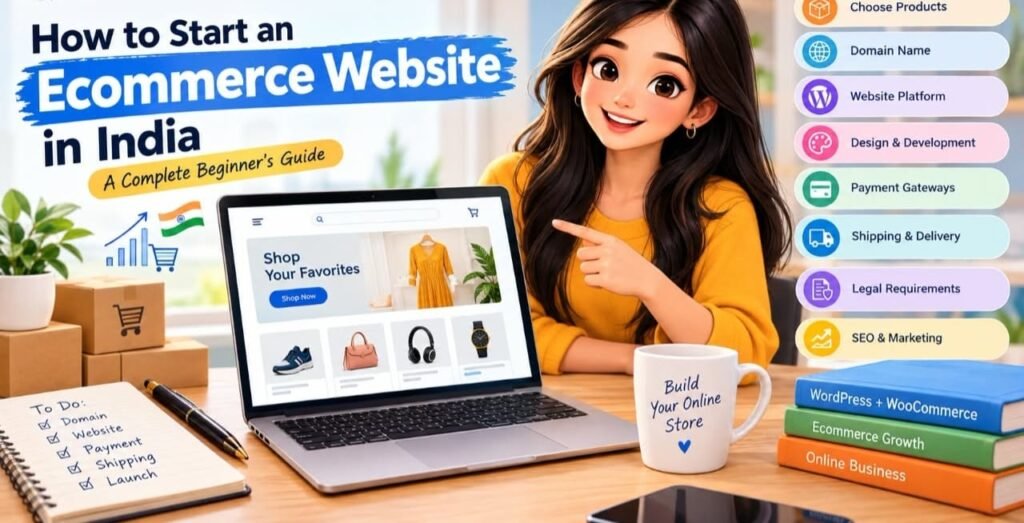
In this guide, we will explain everything you need to know, from choosing your products and domain name to website development, payment gateways, shipping, and SEO.
1. Decide What You Want to Sell Online
Before creating your ecommerce website, decide which products you want to sell.
Your product selection influences your target audience, website design, pricing, marketing strategy, and business model.
Here are some popular ecommerce product categories:
- Clothing and fashion accessories
- Beauty and skincare products
- Home decor and lifestyle products
- Electronics and accessories
- Handmade and personalized gifts
- Health and wellness products
- Digital products, where applicable
How to Choose the Right Products
Consider these factors before finalizing your products:
- Market demand: Are people searching for these products?
- Competition: Who else is selling similar products?
- Profit margin: Can you cover product, shipping, marketing, and other costs?
- Target audience: Who is most likely to buy your products?
- Product sourcing: Can you maintain a reliable supply?
Pro Tip: Start with a focused product category instead of adding too many unrelated products. This makes it easier to understand your customers and build a clear brand identity.
2. Choose a Domain Name for Your Ecommerce Website
A domain name is your website’s online address, such as yourbrand.in or yourbrand.com.
Choose a domain name that is simple, memorable, easy to spell, and relevant to your brand.
Before registering your domain:
- Keep the name short and easy to remember.
- Avoid complicated spellings and unnecessary numbers.
- Check whether the matching social media usernames are available.
- Choose an appropriate domain extension, such as .in or .com.
- Make sure the name does not conflict with another brand or trademark.
A professional domain name helps customers recognize your brand and find your online store more easily.
3. Select the Right Ecommerce Website Platform
Choosing the right platform is one of the most important decisions when starting an ecommerce business.
Your platform affects website customization, product management, payment integration, maintenance, and future growth.
Here are three common options.
A. WordPress + WooCommerce
WooCommerce is an ecommerce platform that works with WordPress.
It allows you to create an online store, manage products, configure shipping, and integrate supported payment methods.
Best for:
- Small and medium-sized businesses
- Startups with a controlled budget
- Businesses that want website customization
- Brands that want to publish blogs and improve SEO
- Businesses that want greater control over their website
B. Hosted Ecommerce Platforms
Hosted ecommerce platforms provide tools to build and manage an online store without managing the entire technical infrastructure yourself.
They can be useful for businesses that prefer a managed solution with integrated store-management features.
However, subscription fees, available features, and customization options vary by platform.
C. Custom Ecommerce Website
A custom ecommerce website is developed according to specific business requirements.
It can be useful when you need specialized functionality, complex integrations, or a unique purchasing process that standard platforms cannot efficiently support.
However, custom development may require a larger initial investment and more ongoing technical support.
Which platform should you choose?
For many small and medium-sized businesses in India, WordPress with WooCommerce is a practical starting point because of its flexibility and extensive customization options.
The best choice ultimately depends on your budget, technical requirements, and business goals.
4. Plan Your Ecommerce Website Design
Your website design influences how customers discover products, understand your brand, and complete purchases.
A professional ecommerce website should be attractive, easy to navigate, and designed with the customer journey in mind.
Make sure your website includes these essential pages:
Homepage
Introduce your brand, highlight important products, and make it easy for visitors to explore your store.
Shop or Product Category Page
Organize products into relevant categories so customers can find what they need.
Product Pages
Include clear product names, high-quality images, prices, descriptions, available sizes or variations, and other relevant information.
About Us Page
Explain your business story, values, and what makes your brand different.
Contact Us Page
Provide reliable contact information and a convenient way for customers to ask questions.
Important Policy Pages
Include appropriate shipping, return, refund, cancellation, privacy, and terms-of-service information.
A well-organized website helps customers shop with confidence and makes your business look more professional.
5. Add Products with SEO-Friendly Descriptions
Adding products to your website involves more than uploading images and entering prices.
Your product pages should help customers understand what they are buying while making it easier for search engines to understand the page.
Follow these best practices:
- Write unique product titles.
- Create clear and useful product descriptions.
- Upload high-quality product images.
- Use descriptive image alt text where appropriate.
- Organize products into relevant categories.
- Add accurate pricing and product information.
- Include relevant keywords naturally.
- Use descriptive URLs.
For example, instead of using a generic title such as “Blue Shirt,” you could use a more descriptive title like “Men’s Blue Cotton Casual Shirt.”
Avoid copying product descriptions from competitors or manufacturers when you can create more useful, original content.
Remember: Helpful product information improves the shopping experience and supports your ecommerce SEO strategy.
6. Set Up Online Payment Methods
Customers need a convenient way to pay for their orders.
Depending on your business model and payment provider, you may be able to offer:
- UPI payments
- Debit and credit cards
- Net banking
- Supported digital wallets
- Cash on Delivery (COD), where suitable
To accept online payments, choose a payment gateway that supports your business and integrate it with your ecommerce platform.
Before selecting a provider, compare its transaction charges, settlement timelines, supported payment methods, integration options, and business verification requirements.
Make sure your website uses HTTPS and follows the payment provider’s security requirements.
Important: Payment gateway approval and available features depend on the provider’s policies and your business documentation.
7. Arrange Shipping and Order Delivery
A successful ecommerce business needs a reliable process for delivering orders.
Before launching your online store, decide how products will be packed, shipped, tracked, and delivered to customers.
You can explore shipping options such as:
- Courier and logistics companies
- Shipping aggregators
- Local delivery services
- Self-managed shipping for eligible orders
Consider the following factors when choosing a shipping solution:
- Delivery coverage across India
- Shipping charges
- Estimated delivery times
- Order tracking
- Return and reverse-pickup support
- Cash on Delivery availability
Clearly display your shipping charges and estimated delivery timelines before customers place their orders.
If you offer free shipping, calculate the cost carefully to make sure it fits your pricing and profit margins.
8. Understand Business Registration and Legal Requirements
The legal requirements for an ecommerce business in India depend on your products, business structure, sales model, and applicable laws.
Before launching, review the requirements relevant to your business.
These may include:
- Choosing an appropriate business structure
- Obtaining applicable registrations and licences
- Understanding GST registration and invoicing requirements
- Complying with applicable consumer protection and ecommerce rules
- Publishing appropriate privacy, shipping, cancellation, and refund policies
- Following product-specific labelling and regulatory requirements, where applicable
GST requirements can vary depending on the nature of your business, the products you sell, and the sales channels you use. Do not assume that every ecommerce seller has identical registration obligations.
Consult a qualified tax professional or the relevant government department to confirm the requirements for your particular business.
9. Optimize Your Ecommerce Website for SEO
Building an ecommerce website is only the first step. Potential customers also need to discover your products.
Ecommerce SEO helps improve your website’s visibility in relevant search results.
Here are some essential ecommerce SEO practices.
Keyword Research
Identify the search terms your potential customers use when looking for your products.
For example, a clothing store might target relevant searches such as “buy cotton shirts online” or “women’s ethnic wear online.”
Choose keywords based on relevance and search intent rather than simply repeating popular terms.
Optimize Product Pages
Use descriptive titles, useful product descriptions, clear headings, and appropriate internal links.
Improve Website Speed
Optimize images, use reliable hosting, and avoid unnecessary plugins or scripts.
Make Your Website Mobile-Friendly
Ensure that customers can browse products, select variations, and complete purchases comfortably on mobile devices.
Create Helpful Blog Content
Publish useful articles related to your products and customers’ questions.
For example, a skincare store could publish guides about choosing products for different skin types, provided the information is accurate and appropriately qualified.
Set Up Google Search Console
Use Google Search Console to monitor indexing, search queries, and website search performance.
SEO takes time, and rankings are not guaranteed. Consistent optimization and useful content can help your website build organic visibility over time.
10. Promote Your Ecommerce Website
Once your website is ready, you need a strategy to attract potential customers.
Here are some ways to promote your online store.
Social Media Marketing: Share product photos, demonstrations, offers, customer stories, and useful content on relevant platforms.
Google Ads and Meta Ads: Paid advertising can help you reach relevant audiences, test product demand, and drive traffic to selected product pages.
Content Marketing: Publish helpful blogs, buying guides, product comparisons, and answers to common customer questions.
Email Marketing: With appropriate consent, share product updates, offers, and useful information with your subscribers.
Customer Reviews: Encourage genuine customer feedback and display authentic reviews where appropriate.
Start with the marketing channels most relevant to your target audience. Monitor traffic, enquiries, purchases, and marketing costs to understand which activities are delivering value.
How Much Does It Cost to Start an Ecommerce Website in India?
The cost of creating an ecommerce website depends on its features, product catalogue, design, integrations, and development approach.
Your total budget may include:
| Expense | What to Consider |
|---|---|
| Domain | Registration and renewal charges |
| Hosting | Storage, performance, and renewal costs |
| Website Development | Design, setup, customization, and testing |
| Ecommerce Features | Product variations, integrations, and additional functionality |
| Payment Gateway | Applicable transaction and service charges |
| Shipping | Packaging, delivery, and return costs |
| Marketing | Advertising, SEO, and content creation |
| Maintenance | Updates, backups, security, and technical support |
A basic WooCommerce store may cost less than a complex custom ecommerce website, but actual pricing varies significantly.
Ask your developer for a clear quotation covering the scope of work, included features, recurring charges, and ongoing maintenance.
Tip: Do not focus only on the initial development price. Consider the total cost of running and growing your online store.
Common Mistakes to Avoid When Starting an Ecommerce Website
Avoid these common mistakes when launching your online business:
- Choosing products without researching demand.
- Using poor-quality product images.
- Ignoring mobile users.
- Making the checkout process unnecessarily complicated.
- Forgetting shipping, returns, and refund policies.
- Installing too many unnecessary plugins.
- Ignoring website security and backups.
- Expecting immediate results from SEO.
- Spending on advertising without tracking performance.
- Launching without testing payments and order notifications.
Taking time to plan and test your store can help prevent avoidable problems after launch.
Conclusion: Start Your Ecommerce Business with the Right Website
Starting an ecommerce website in India becomes easier when you follow a clear plan.
Choose the right products, register a suitable domain, select an ecommerce platform, create useful product pages, configure payments and shipping, and optimize your website for search engines.
Most importantly, focus on providing a smooth and trustworthy shopping experience.
If you are starting a small or medium-sized online business, a professionally developed WordPress and WooCommerce website can be a flexible solution. If your requirements are more complex, consider whether a hosted platform or custom development would better suit your business.
Need an Ecommerce Website for Your Business?
At ClickUno, we help businesses establish their online presence through website development and digital services.
Whether you need a WordPress business website, a WooCommerce online store, or a customized website solution, start by identifying your business goals and required features.
Visit https://clickuno.in/ to explore our services and take the next step towards building your online business.